
INR21700-EL70
ELITIUM EL70
One 21700 that holds capacity and current at the same time, and two operating modes to choose between.
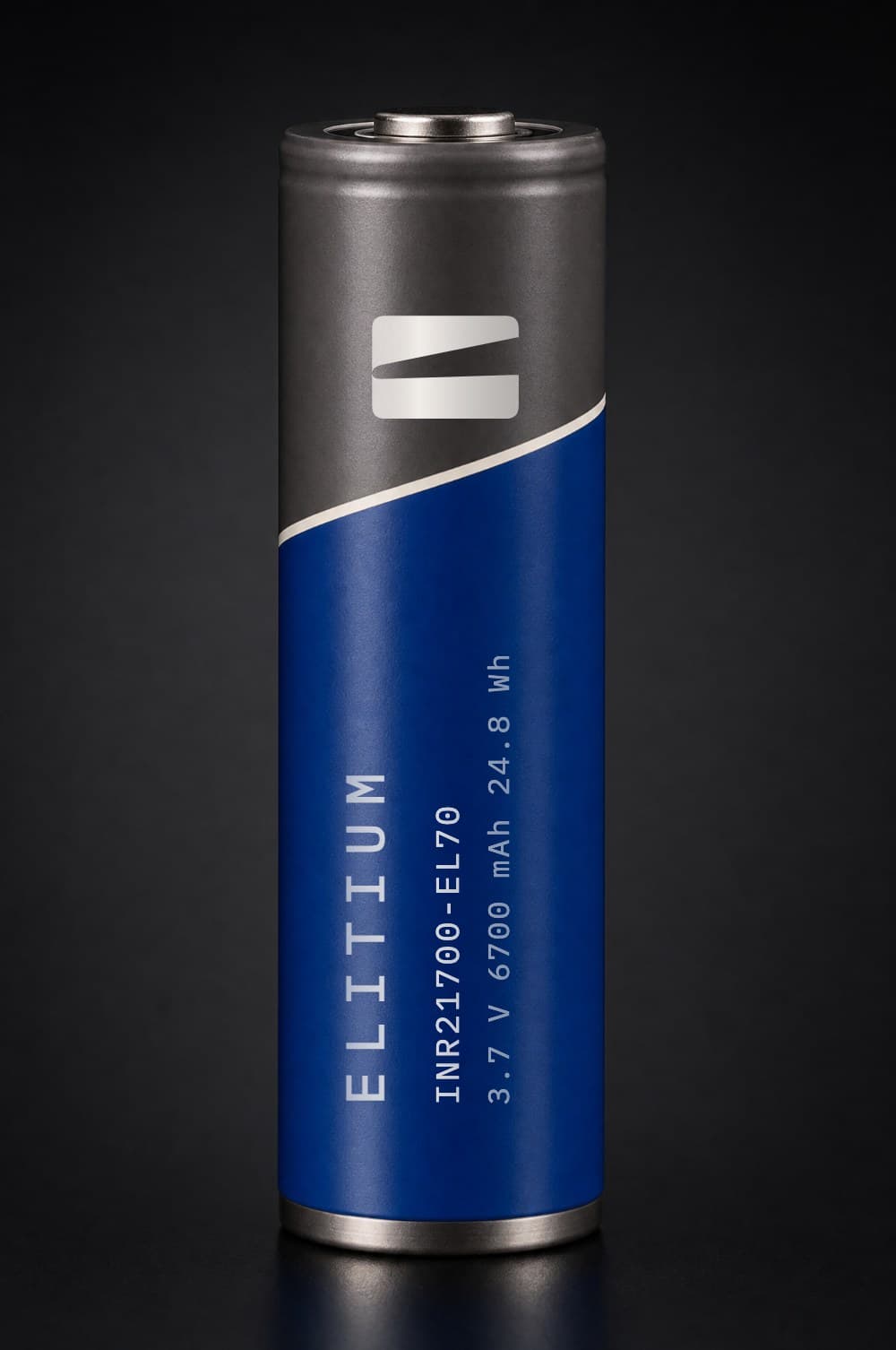
Turn it over
Drag the cell to turn it, or use the arrow keys.
The four figures
What a pack designer decides on, at the high-energy profile.
- 6700 mAhNominal capacityMeasured in High energy
- 24.8 WhNominal energyMeasured in High energy
- 60 AMaximum continuous discharge
- ≥344 Wh/kgSpecific energyMeasured in High energy
Two operating modes
The same cell, two charge profiles. The profile is set in the charger and the battery management system, and it decides which of the two products you are holding.
Standard
6000 mAh · 850 cycles
High energy
6700 mAh · 50 cycles
What the EL70 does that a standard 21700 does not
One cell holds capacity and current at the same time. In this format that pair is normally a trade: the high-capacity cells are not the high-current cells, and the high-current cells are not the high-capacity ones.
24.8 Wh+18 %
More watt-hours out of the same cell
Same cell, same 21700 footprint, same mass. The extra energy comes from the charge profile, and eighteen per cent more energy is eighteen per cent more time in the air.
≥344 Wh/kg
Energy per gram, where grams decide the mission
Figured at the maximum cell mass, so the real cell can only be better. Every gram that does not fly is a gram of payload that can.
60 A150 A / 2 s
Capacity without paying for it in current
A pack built on this cell does not have to choose between endurance and the power an airframe asks for on climb-out or in a burst.
−40 °C50 %
It still works at forty below
Half of rated capacity at −40 °C, and it discharges up to 75 °C. Winter and altitude stop being a separate engineering problem.
The comparison is against this same cell charged to 4.20 V.
Specify a pack around this cell
How many cells you need
Set the cells in series and in parallel. Everything below is computed from the specification.
- Cells
- 12
- Energy
- 297.5 Wh
- Nominal voltage
- 22.2 V
- Capacity
- 13400 mAh
- Cell mass
- 864 g
What that is in a pack
The same figures, arranged the way an airframe carries them.
| Configuration | Cells | Energy | Nominal voltage | Capacity | Cell mass |
|---|---|---|---|---|---|
| 6S2P | 12 | 297 Wh | 22.2 V | 13400 mAh | 864 g |
| 12S4P | 48 | 1190 Wh | 44.4 V | 26800 mAh | 3456 g |
Cell mass only, at the maximum weight per cell. A finished pack also carries management electronics, interconnects and a housing. Figures are for the high-energy profile.
Specification
Where a figure changes with the operating mode, both modes are given.
| Parameter | Standard | High energy |
|---|---|---|
| Electrical | ||
| Nominal capacityRating charge 3.0 A CC-CV, 120 mA termination; discharge 1.2 A to the cut-off. | 6000 mAh | 6700 mAh |
| Minimum capacity | 6000 mAh | 6630 mAh |
| Nominal voltageMean operating voltage. | 3.50 V | 3.70 V |
| Nominal energyCapacity × nominal voltage. | 21.0 Wh | 24.8 Wh |
| Charge voltage limit | 4.20 V | 4.45 V |
| Discharge cut-off voltage | 2.50 V | 1.80 V |
| Delivery voltageWithin 10 days of leaving the plant. | 3.4–3.6 V | 3.4–3.6 V |
| Recommended chargeConstant current, then constant voltage until the current falls below 134 mA. About 6 hours. | CC-CV 1.2 A → 4.20 V | CC-CV 1.2 A → 4.45 V |
| Recommended discharge | CC 1.2 A → 2.50 V | CC 1.2 A → 1.80 V |
| Maximum charge currentCharge time about 30 minutes, for reference. | 12 A | 12 A |
| Maximum continuous dischargeAt room temperature. Up to 110 A with an 80 °C surface cut-off. Not intended for cycling. | 60 A | 60 A |
| Maximum pulse dischargeNot intended for cycling. | 150 A / 2 s | 150 A / 2 s |
| Internal impedance (AC)1 kHz, measured at 30 % state of charge. | ≤4 mΩ | ≤4 mΩ |
| Internal resistance (DC) | <20 mΩ @ 25 °C · <100 mΩ @ −20 °C | <20 mΩ @ 25 °C · <100 mΩ @ −20 °C |
| Pre-charge window | 1.0–3.0 V @ 0.7–3.4 A | 1.0–3.0 V @ 0.7–3.4 A |
| Physical | ||
| Diameter | 21.30 ±0.1 mm | 21.30 ±0.1 mm |
| Height | 70.50 ±0.3 mm | 70.50 ±0.3 mm |
| Weight | ≤72 g | ≤72 g |
| Specific energyA floor, computed from the maximum weight — the figure can only be better. | ≥292 Wh/kg | ≥344 Wh/kg |
| Energy density | ≥836 Wh/L | ≥987 Wh/L |
| Environment | ||
| Charge temperatureCharging below 0 °C lowers efficiency and shortens service life. | 0…60 °C | 0…60 °C |
| Discharge temperatureCell surface temperature. | −40…75 °C | −40…75 °C |
| Storage temperature, up to 6 monthsRelative humidity 60 ±25 %. | −20…25 °C | −20…25 °C |
| Storage temperature, up to 3 months | −20…45 °C | −20…45 °C |
| Storage temperature, up to 1 month | −20…60 °C | −20…60 °C |
| Storage state of chargeRecharge about every six months to prevent over-discharge. | 30–50 % | 30–50 % |
Both energy densities use the maximum cell mass, so they are floors — a cell can only be better than the figure given.
Measured behaviour
Capacity against discharge current
Charged 6 A CC-CV, 300 mA termination; discharged at room temperature. Referenced to the 1.2 A capacity at 25 ±3 °C.
| Discharge current | Capacity |
|---|---|
| 1.2 A | |
| 6 A | |
| 18 A | |
| 30 A | |
| 50 A |
Capacity against temperature
Discharged at 6 A after a standard charge. Referenced to 25 ±3 °C. If charge and discharge temperatures differ, three hours are allowed between them.
| Temperature | Capacity |
|---|---|
| −40 °Cmeasured to 2.2 V | |
| −20 °C | |
| 0 °C | |
| 25 °C | |
| 60 °C |
Cycle life
Cycles until capacity falls to 80 % of the initial value.
| Cycles | Measured in | Test conditions |
|---|---|---|
| 850 | Standard | Charge 6 A CC-CV to 4.20 V, 300 mA termination, 10 min rest. Discharge 6 A to 2.50 V, 30 min rest. |
| 340 | Standard | Charge 6 A CC-CV to 4.20 V, 300 mA termination, 10 min rest. Discharge 30 A to 2.50 V or 75 °C, 30 min rest. |
| 50 | High energy | Charge 6 A CC-CV to 4.45 V, 300 mA termination, 10 min rest. Discharge 30 A to 1.80 V or 75 °C, 30 min rest. |
High-temperature storage
Stored 30 days at 60 °C from a full charge, then discharged at 3 A to the cut-off at 25 ±3 °C.
Capacity recovery ≥90 % of the rated capacity.
Safety testing
Every test below is performed after a 4.20 V standard charge, which is the condition on file. The 4.45 V high-energy profile has not been safety-validated, and nothing here should be read as saying it has.
| Safety testing | Test conditions | Criterion |
|---|---|---|
| Forced discharge | A discharged cell reverse-charged at 6 A for 90 minutes. | No fire, no explosion. |
| Overcharge | Charged at 18 A until 10.0 V, or for one hour. | No fire, no explosion. |
| External short circuit | Terminals shorted through 5, 10, 20 and 80 mΩ for 10 minutes, then observed for one hour. | No fire, no explosion. |
| Drop | Dropped onto concrete from 1.0 m in a random orientation, rested one hour, then inspected. | No fire, no explosion. |
| Thermal shock | Heated at 5 °C per minute to 130 °C and held for 30 minutes. | No fire, no explosion. |
| Crush | Compressed between flat surfaces by a 32 mm ram until the force reaches 13 kN. | No fire, no explosion. |
Specify a pack around this cell
Packaging
Four cells to a box, seated in a foam tray. The front carries the three figures you decide on: energy, current and temperature.
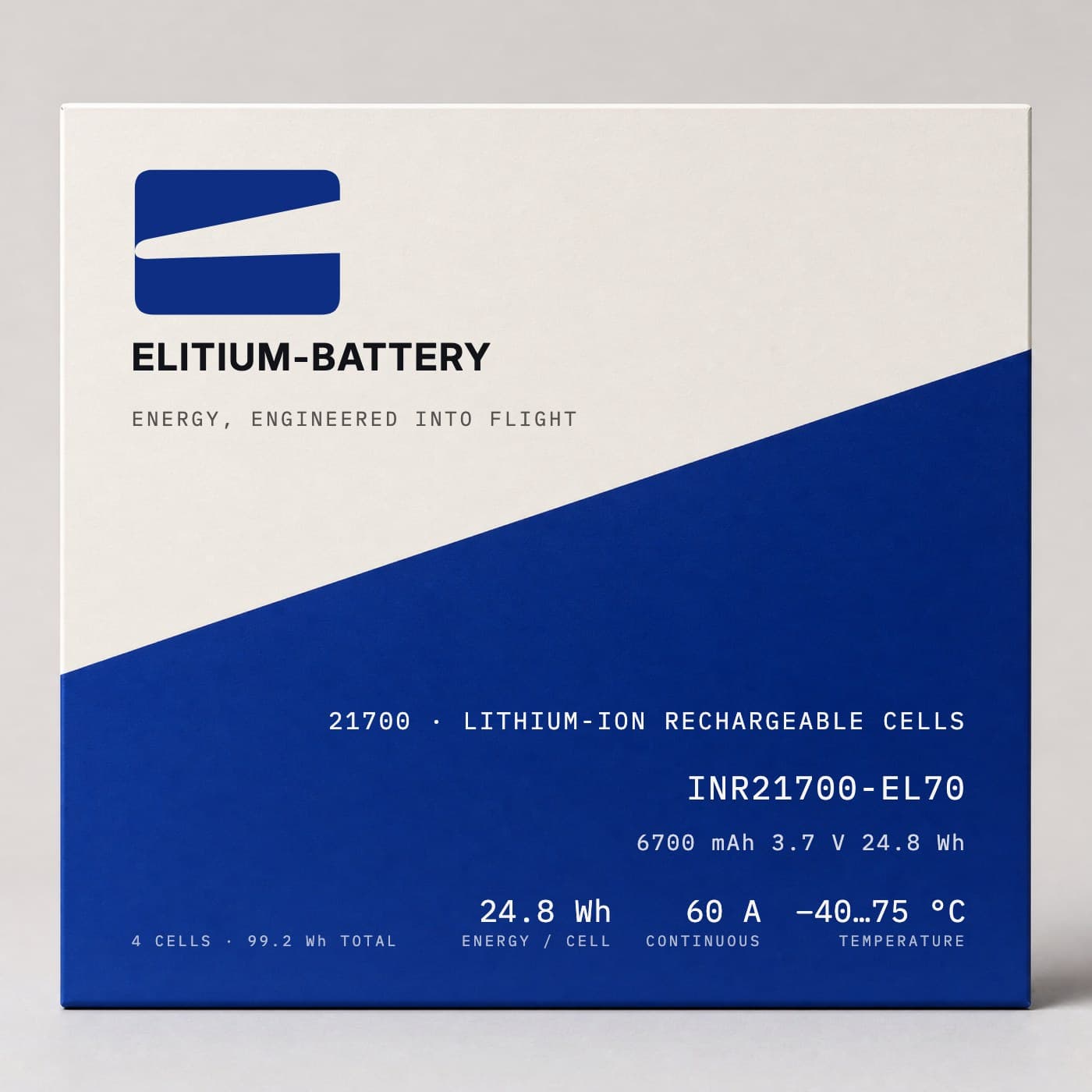
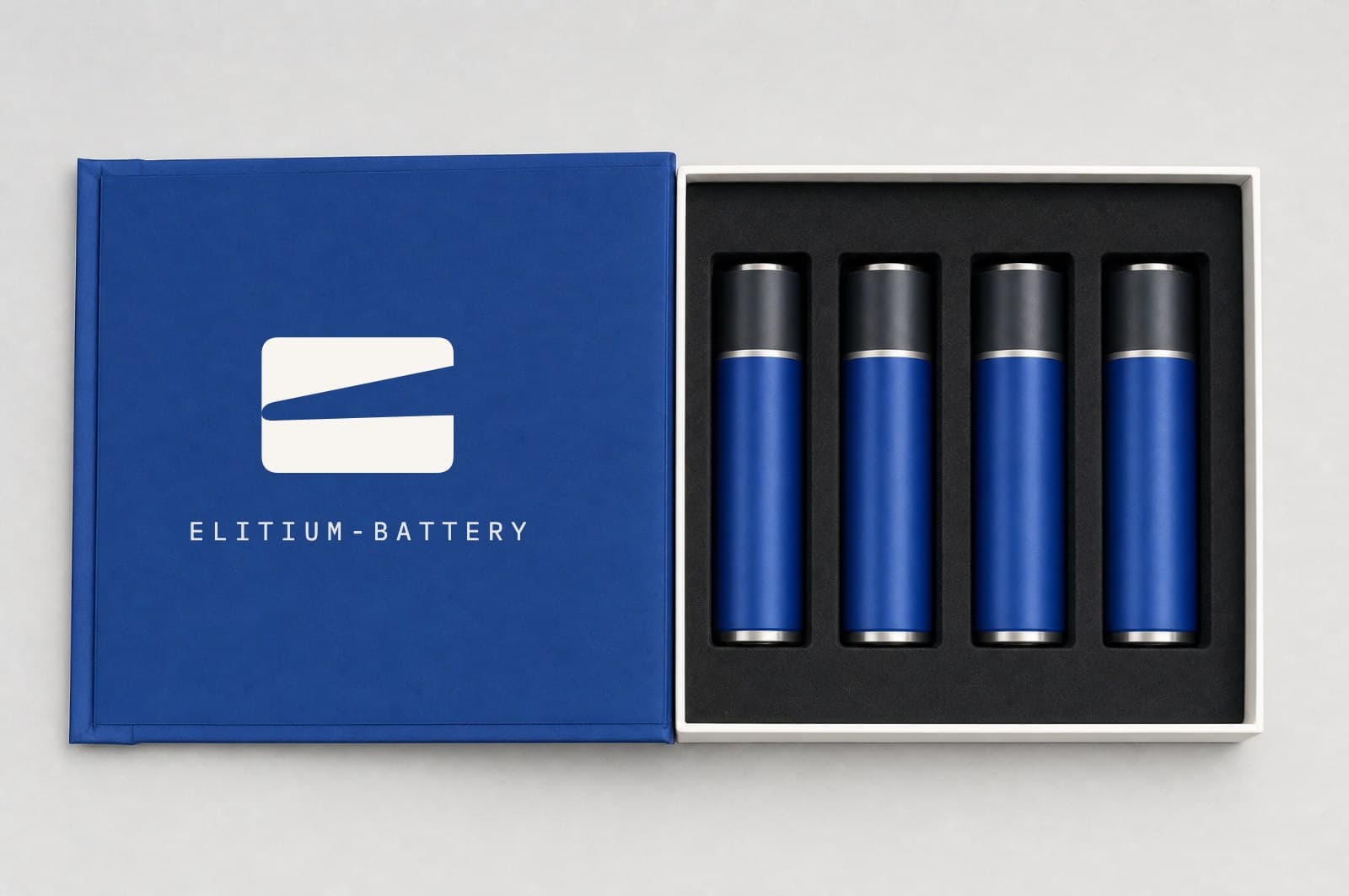
Renders of the packaging with the printed artwork applied. Not photographs.
What is printed
- ELITIUM-BATTERY
- ENERGY, ENGINEERED INTO FLIGHT
- 21700 · LITHIUM-ION RECHARGEABLE CELLS
- INR21700-EL70
- 6700 mAh 3.7 V 24.8 Wh
- 4 CELLS · 99.2 Wh TOTAL
- 24.8 Wh ENERGY / CELL
- 60 A CONTINUOUS
- −40…75 °C TEMPERATURE
Printed text is English in every market, like the marking on the cell itself. The box carries no service-life badge: at the high-energy profile it would not be true.
Marking
ELITIUM authors its own marking rule. Every cell carries the LIFT APERTURE symbol, the wordmark, the model, the rating and a date code.
- ELITIUM
- INR21700-EL70
- 3.7 V
- 6700 mAh
- 24.8 Wh
- + / −
These are the characters on the cell itself, printed in English in every market.
The cell from every side
The marking repeats three times around the cell, so a full block faces you whichever way it is lying in the tray.
Dimensions
Handling and storage
Warranty: One year from shipment against manufacturing defects.
- Never expose the cell to fire or place it near a heat source.
- Never reverse the terminals in a charger or a device.
- Never short the terminals.
- Do not disassemble, deform or immerse the cell.
- Do not mix with cells of another make, type or model.
- Charge only in equipment intended for this cell, and never leave it charging longer than 24 hours.
- Store cool, dry and ventilated; dispose of cells under local regulations.
Specify a pack around this cell
Tell us the platform, the endurance you need and the discharge profile it flies. We will come back with a cell count, a pack architecture and what it weighs.
Start an engineering conversation